
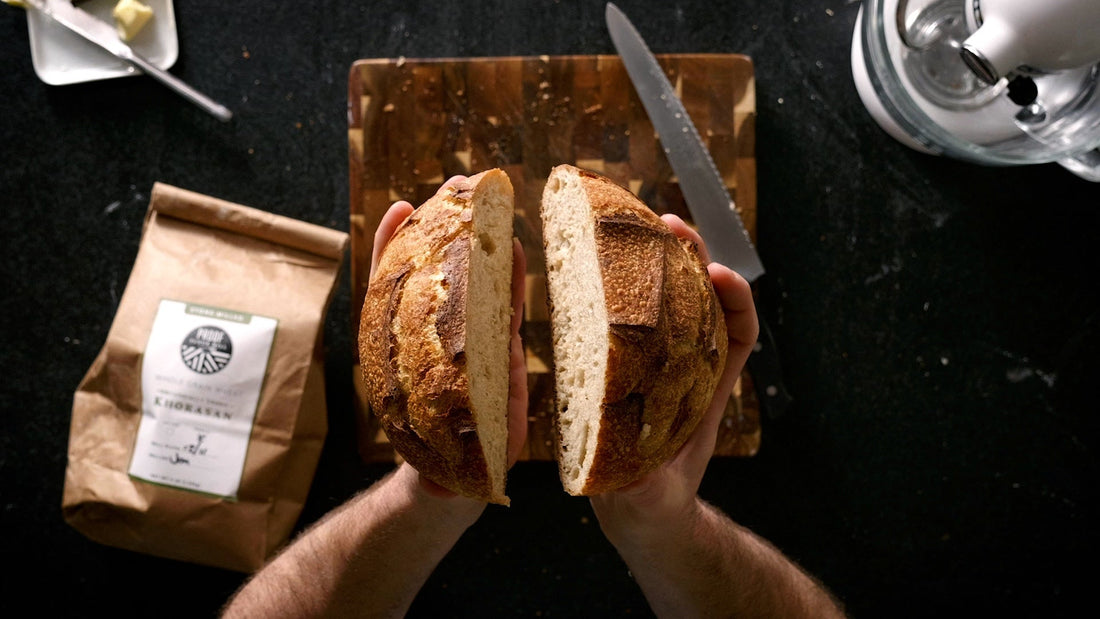
Khorasan Sourdough Bread
Share
This advanced yet approachable Khorasan bread recipe highlights the deep, nutty flavors of this ancient grain, yielding a soft, long-lasting loaf. The key is incorporating a scalded porridge made from Khorasan flour, which enhances moisture retention and tenderness.
Ingredients
Porridge (Scalded Khorasan Mixture)
270g boiling water
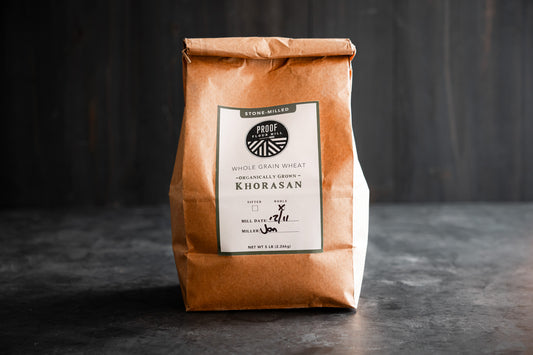
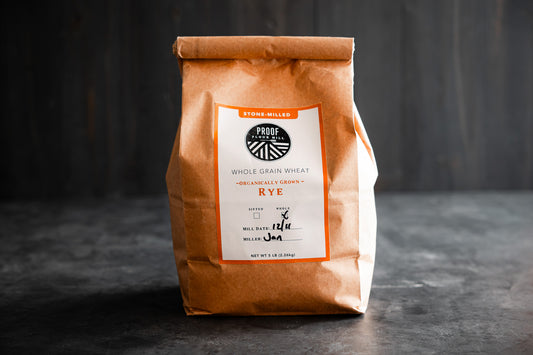
135g Khorasan flour (organically grown, stone-milled)
Main Dough
539g Type 85 Central Milling Flour (base flour)
136g sourdough starter (mature & active)
303g ice-cold water (to balance dough temperature)
13g salt
30g honey (for subtle sweetness)
Instructions
Step 1: Prepare the Porridge (Scalded Khorasan Mixture)
Bring 270g of water to a boil. Gradually whisk in 135g of Khorasan flour, stirring continuously to avoid lumps. Mix until a thick, cohesive porridge forms. Transfer the mixture to a bowl and allow it to cool naturally or speed up cooling by placing it in an ice bath. Once it reaches room temperature (~80°F/27°C), it's ready to incorporate into the dough.
Step 2: Mixing the Dough
Combine ingredients: In a large mixing bowl, add the cooled Khorasan porridge, 539g of Type 85 flour, and 303g of ice-cold water. Add sourdough starter: Mix in 136g of sourdough starter, ensuring it is evenly distributed. Incorporate the salt separately: Measure 13g of salt and set it aside for now. Begin mixing: Use a stand mixer with a paddle attachment on low speed until ingredients start to come together. Add honey: Once incorporated, slowly drizzle in 30g of honey. Develop the dough: Increase mixing speed to medium (speed 3–4 on a KitchenAid). Mix for 7–10 minutes, or until the dough becomes smooth and elastic. The dough should start pulling away from the sides of the bowl. Check consistency: If the dough is still sticky and loose, continue mixing until it forms a more cohesive mass.
Step 3: Bulk Fermentation & Stretch and Folds
First rise (3 hours): Transfer the dough to a warm place (~75–80°F/24–27°C). First stretch & fold: With wet hands, gently stretch the dough from one side and fold it over itself. Repeat on all four sides. Let rest for 30 minutes. Second stretch & fold: Repeat the stretch-and-fold process, working on a clean surface if needed. Let rest for 30 more minutes. Final stretch & fold: Perform the last fold and allow the dough to rise for another 30 minutes (total bulk fermentation time ~5 hours).
Step 4: Shaping the Loaves
Divide the dough: Turn the dough onto a floured surface and portion into two loaves (~680g each). Shape: Flip each portion over, gently stretch, and fold the edges into the center to create surface tension. Prepare the proofing baskets: Lightly flour a banneton (or use a bowl lined with a floured tea towel). Optionally, dust the loaf with rice flour to prevent sticking. Final proof (cold fermentation): Cover and refrigerate overnight for 12+ hours to develop flavor and structure.
Step 5: Baking
Preheat oven & Dutch oven: Set the oven to 415°F (213°C) and place a Dutch oven inside to preheat for 1 hour. Prepare the loaves for baking: Turn out a loaf onto parchment paper. Score the top with a simple square or cross pattern using a bread lame or sharp knife. Bake covered: Place the loaf into the Dutch oven, cover, and bake for 20 minutes to trap steam. Uncover & finish baking: Remove the lid and continue baking for 10–12 minutes until the crust is deeply golden brown. Cool completely: Transfer to a wire rack and let the loaf rest for at least 1 hour before slicing.
Step 6: Enjoy!
This Khorasan bread has a soft, silky crumb with a rich, nutty flavor, mild sweetness from the honey, and excellent shelf life. Perfect for sandwiches, toast, or just with butter.
11 comments
A baker profits from both watching the video and reading the recipe – the video answers such questions as when the salt is added and explains that there is a choice between adding cold water and allowing the porridge to cool – not both. Neither gives a DDT, but let’s guess that a typical ~75-80F is right. Also, the video helps calibrate what sort of structure is sought, and how aggressive the stretch-and-folds should be – much more than is my custom. Thanks for making both available.
The salt goes in when the base flour is added
Why are you ignoring the question that was asked several times in the above comments:
WHEN IS THE SALT TO BE ADDED?
Than k you very much!
I appreciate your providing home baker scaled recipes. For years I would watch your YouTube videos and try to scale down what you were doing. Some odd things in the recipe. In Step 2 you say to measure and hold back the salt to be used later. The recipe does not tell us to then add it. I added it when I normally would, but the recipe is silent. For step 3, it starts off suggesting a 3 hour first rise and then ends by suggsting a 5 hour total bulk. I am unsure as to where the extra two hours fits in. I am in the middle of baking this for the first time, I look forward to the finished loaves.